
I had just left Google, and I was sitting in a coffee shop in Shanghai, trying to work out where in China would be the best place to start a business.
I wanted to treat it like a blank slate. An American might have biases about California vs. Texas, or Florida vs. New York, and people in China have the same kinds of biases about different regions. I wanted to go in with as few of them as possible, and that meant one thing: start with the data.
In mid-2019, I looked up GDP and population growth trends for China’s second-tier cities — the big regional hubs just below Beijing, Shanghai, Guangzhou and Shenzhen. I skipped the giants to keep costs down, and I skipped smaller cities because, as an American, getting anything done on a foreign passport there would have been very challenging. Formal processes like registering a company just aren’t set up for foreigners in most smaller cities.
My only real bias was the weather: I preferred Northern China, because much of Southern China is hot and humid for most of the year. That narrowed it down to three cities:
- Dalian, a coastal city in the Northeast; GDP up 6.5%. Population +0.6% (2019 YoY)
- Zhengzhou, nicknamed “iPhone City,” home to the Foxconn plant that builds roughly half of the world’s iPhones; GDP up 6.5%. Population +2.1%.
- Xi’an, an ancient capital and one of China’s cultural centers, in the Northwest; GDP up 7.0%. Population +2.0%.
But numbers only tell you so much about what it’s like to actually live and build something in a place.
So what better way to find out whether a city is right for you than to go and visit? Before each trip, I posted on Douban — a Chinese discussion site a bit like Reddit — in the forum for each of the three cities. The post went something like:
“Hi, I’m from the Bay Area and was a product manager in tech. I’m planning to visit [city] for a few days and would be happy to give a mock interview.”
Dalian
One person responded to the Dalian post. Bob was a chemistry major about to graduate from a local university, and he was applying to Tencent as a PM. So I went to Dalian, and that was the one and only time I’ve held a mock interview inside a chemistry lab — the kind with beakers and flasks everywhere. We talked for an hour, and I helped him work on how he approached interview questions.
As I was leaving, Bob said, “Wait!” He asked why I’d made such an anonymous post — a lot of people had assumed it was a scam. Had he known my background in big tech, he said, he could have set up a big event for me to give a talk to his entire class.
“I know what you’re saying,” I told him.
But my goal was to see how locals responded to a stranger, because that’s exactly who I’d be if I started fresh in a new city. I wanted to know how a place welcomed outsiders.
Dalian was a great city, but the conversations with locals leaned more toward buying a home and settling down—and less toward learning and growing. That’s a perfectly reasonable goal. But at that stage of my life, I wanted to be around people eager to learn something new, especially if I was going to build a business around teaching. During my short visit, I hadn’t found enough of that interest to picture starting there.
Zhengzhou
The Zhengzhou post devolved into an absolute mess. People accused me left and right of being a scammer — there was no shortage of online trolling. Ironically, one of the accusations came from someone whose profile said “Software Developer at Google.”
When I visited, I did end up meeting some friends of friends, but the only questions I got were:
“Why would you want to move here?”
“Is your wife living here?”
(No.)
“Well, even if you do bring a wife and kids here, your kids are going to suffer in the gaokao.”
The gaokao is China’s college entrance exam, and Henan, the province Zhengzhou is the capital of, is known as one of the toughest places in the country to take it — in 2019, about 1 million students there signed up for it, more than in any other province.
At that point I was a little dejected. Two cities down, and neither was the right fit.
Xi’an
The response in Xi’an was completely different. A woman who said she was a PM offered to help me organize a large sharing session and invite more than 50 people to hear me talk about PM interviews. I said, “Whoa, whoa — that’s a bit too formal. My goal is also to get to know people. How about we just get 10 or so people in a room and do a smaller session?”
So that’s what we did. We ended up booking a small room inside a coffee shop — about 50 meters from where I’m writing this post. We talked about product strategy “Design a ride-hailing app for older people”, estimation questions, and whether technical questions may come up.
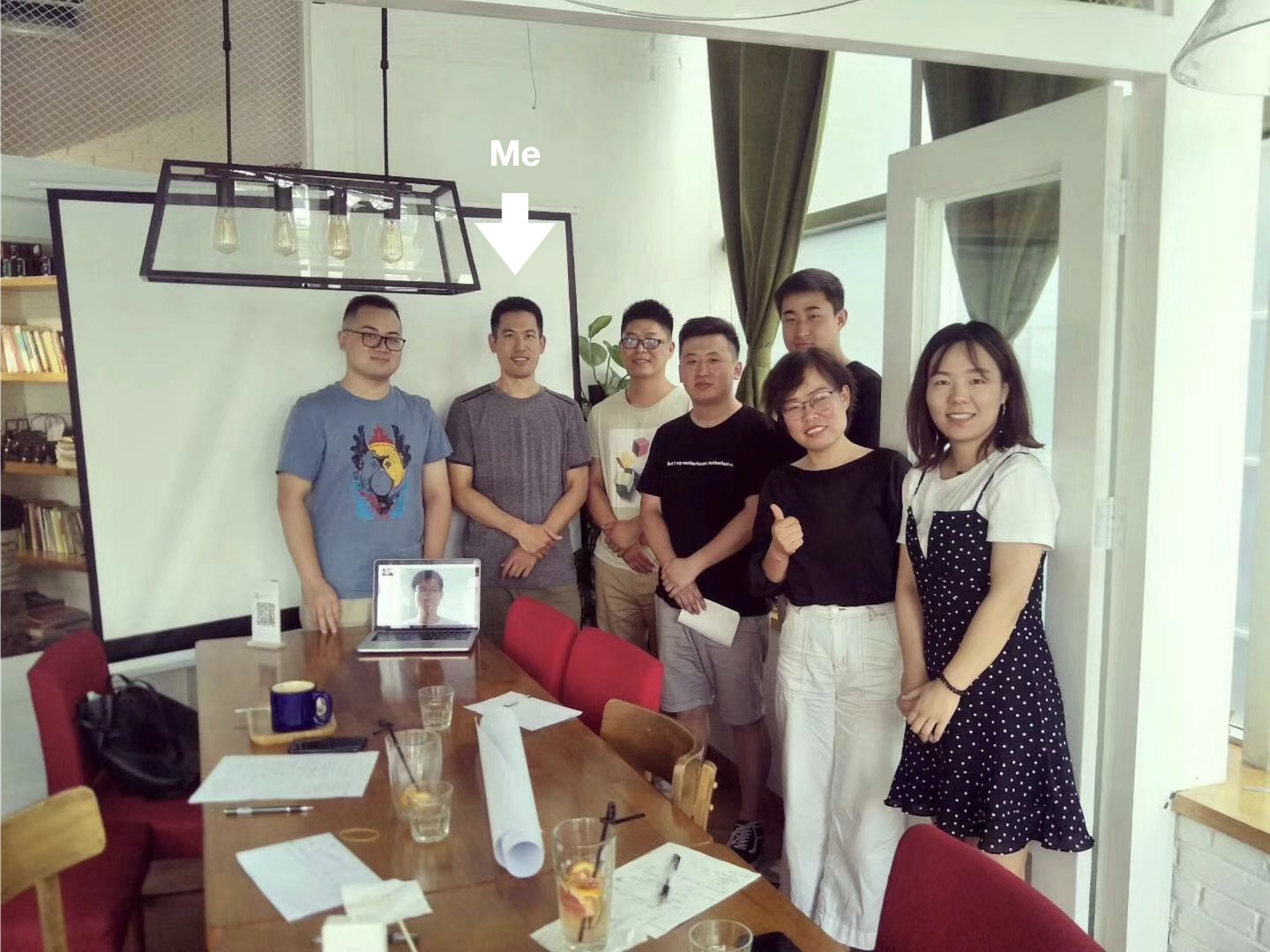
(The session in 2019 - one person even joined via video)
By the end of the trip, Xi’an had left a strong impression. The people I met weren’t as hyper-competitive as the crowds in Beijing or Shanghai, but they wanted to learn and grow. And if I was going to start a business built around teaching, at least there’d be a receptive audience.
So I moved to Xi’an. Despite some early challenges during COVID, I found my first group of students and customers by running local English communication events. Xi’an is also where I landed my first business deal (a story for another day).
Looking back
I know we don’t always have the luxury of choosing where we live. We’re limited by job opportunities and family situations. But maybe this gives you a few ideas. I took a methodical approach, the same way I approach product problems: I started with data to understand the broad trends, moved to observation, then went out to talk to people and gather live inputs.
Friends have asked whether I’d choose Xi’an if I could do it all over again. The answer is “absolutely, yes.” It was the right place for the right time. So depending on your business or stage of life, finding people, talent, or a community on the same wavelength is so important — it means you’re swimming with the current instead of against it. Because trust me, you’ll have plenty of other challenges to deal with along the way.