
“Do you need KPIs?”
I went back to visit some former Google coworkers about a year into my startup journey, and a group of us chatted about this.
“Of course he has KPIs,” someone said.
“He doesn’t need KPIs,” another countered.
I smiled.
I’d spent ten years inside companies where key performance indicators (KPIs) were everywhere — on dashboards, in performance reviews, on the first slide of every quarterly review.
They had always been there. Sometimes they helped; sometimes they didn’t quite capture what we were trying to accomplish. But could I defend the alternative: what if we didn’t have KPIs?
Why I wanted to understand organizations
Starting a business was about taking on the challenge of building something of my own. But there was a second goal: I wanted to understand why organizations worked the way they did. When were KPIs useful? How was organizational culture formed?
Whether I eventually scaled my own team to 50 or joined someone else’s, I wanted a better understanding of why organizations worked this way.
After over a decade of working in large orgs, I had a rough feel for the good and bad. I’d worked with managers and coworkers who could be stuck on decisions for months, “analysis paralysis” — morale slowly draining while everyone waited. I’d encountered managers who micromanaged — which often hurt more than it helped. I’d seen competition between teams who even tried to undermine each other.
There were good things I wanted to carry forward, too. HP felt like a family. Apple encouraged internal networking. At Google, I saw intellectual curiosity driving productivity, with people keeping their egos in check because they were more interested in solving the problem.
So I had a rough map of the good and the bad. What I didn’t have was a way to test it. My own company became a small laboratory: could I build an environment from scratch, keep the good parts, and leave the bad parts out?
Running a small team gave me a way to see how everyday leadership choices played out.
1. Anchor: pick a direction
Have you ever been on a team that couldn’t decide whether to go left or right? It doesn’t actually stand still. Everyone starts running in their own direction, and pulling them back together later costs everyone time. So I came to believe that picking a direction usually beats waiting, especially if you can change your mind later. The team just needs to understand “what would make us change course?”
My startup gave me plenty of practice. At different points, offline events struggled, online content struggled, partnerships struggled, and product sales dipped. Instead of stopping when one track struggled, we needed to be able to shift our attention to another.
When online sales slowed down, we didn’t panic. We cut the team’s time spent on online products from about 80% to 20% and put the rest into corporate partnerships. The goal was still the same: helping people communicate better at work. We were just changing the channel through which we put effort.
The tracks also supported each other. Coaching teams and shadowing meetings kept me close to how communication at real companies was changing, and those observations fed back into online content for a broader audience. We weren’t starting over with every shift. We were building knowledge we could use across the business, and staying ready for customers who weren’t receptive one quarter but became ready the next.
Naturally there are differences between small companies and mature organizations. Big companies usually can’t switch tracks as freely as a small team can, and that’s fine. But I’d still leave some room to change, so the team doesn’t get anxious every time plans shift. And when there’s no clear direction at all? Make exploring part of the goal, and figure it out together.
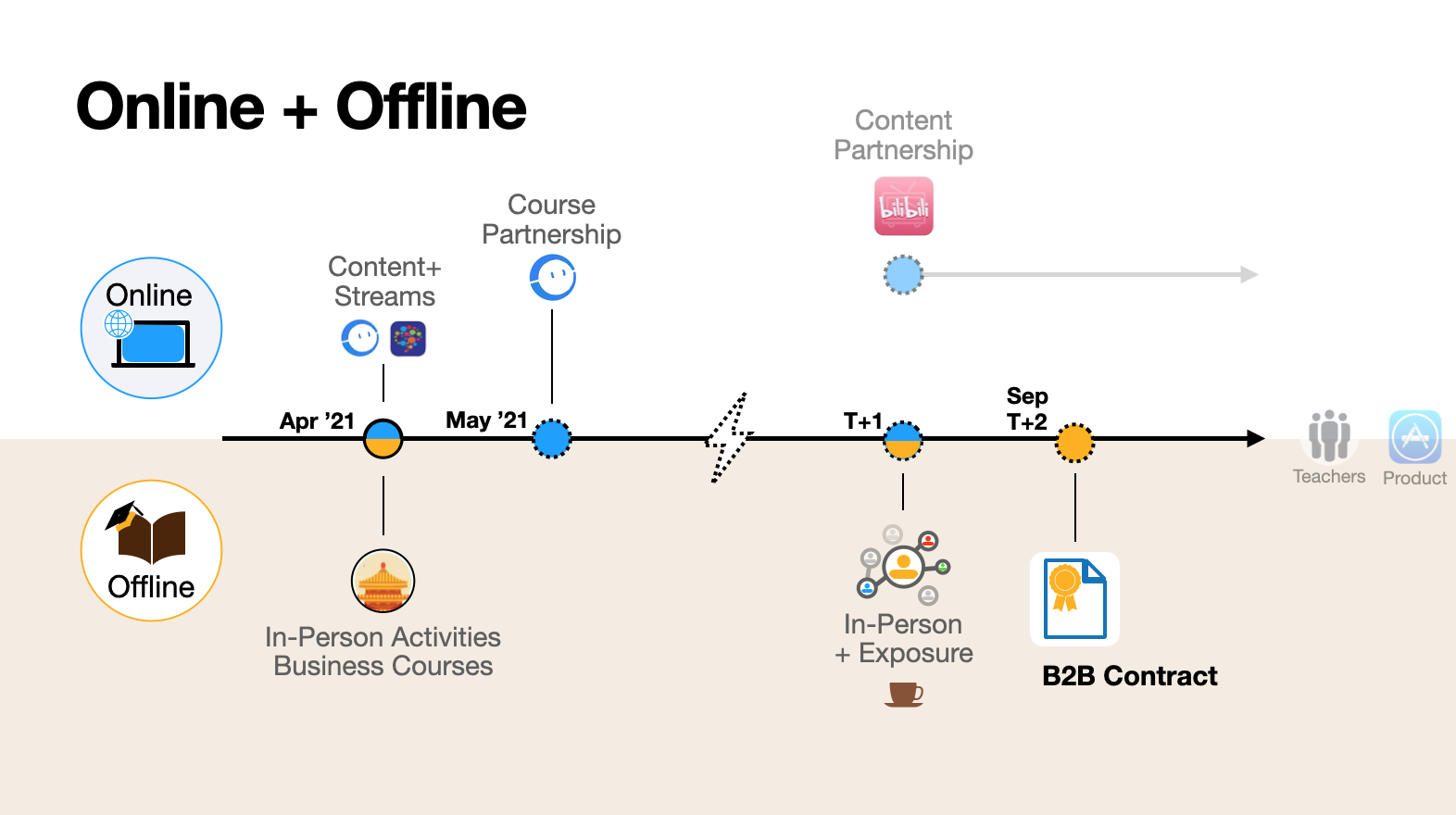
(From my actual 2021 strategy deck, sequencing with flexibility: offline activities, online partnerships, and a B2B contract)
2. Move: watch progress, but don’t stare
When I was testing different directions early on — general English vs. business communication, or product consulting vs. product development — it was difficult to set traditional KPIs. Maybe I targeted 100k in annual revenue or 10k monthly active users (MAU), but that wouldn’t tell me much when many of the directions I tried would fail. The failures would have also been damaging to team morale “We missed it again?”
What I did instead was set a different kind of KPI: # of paths explored — for example, try three different product directions in three weeks — and make sure we learned at least one or two things from each failed attempt. Tracking was especially helpful when attempts failed. When we hit bumps in the road, it helped us see what we ruled out and what we learned. We could see that we were still making progress (3 attempts, 5 learnings). That made the extra time spent setting and tracking those targets worthwhile: it helped us maintain forward momentum.
But here’s an important point: the KPI is not the goal itself, only a measure of progress toward it. That’s why setting a direction (anchor) comes before movement. It’s like driving: the speedometer tells you how fast you’re moving, but it can’t tell you whether you’re heading somewhere useful. You need a destination first.
For my online products, it was nice to see videos reaching more than 10,000 views — it told me something about reach and interest. The platform’s data showed that my save rates above 10% ranked in the top 0.01%, suggesting that people wanted to return to the material. But it was important not to get caught up in these numbers, because they didn’t tell me whether people were really learning and applying the material — that required a slower process of phone interviews and testing what they’d learned.
In larger organizations, layers and layers between the vision set by leadership and the team on the ground make that distinction even more important. The message often gets lost, and the team can get caught up in numbers. Each layer can unintentionally distort the KPIs into the goals. Technology teams often end up improving technical metrics while losing sight of the customers they’re supporting.
So it’s important to remember — tracking KPIs helps a team see and feel progress. Leadership’s job is to make sure the team realizes how that progress still serves the goal.
3. Accelerate: help people contribute without waiting for you
Accelerating came to mean one thing to me: more people able to make a useful contribution without waiting for leadership to interpret everything. That depends on how quickly a team can take in information, digest it, and act on it — something I started calling information metabolism.
Every member of my core team of five started out as a follower of my content before joining. They already cared about the work, and I valued that commitment. Their day-to-day work was content review, administration, community management, and customer service. But I wanted them to grow, so I held separate sessions just for them and taught basic PM skills, how to brainstorm new ideas, how to prioritize requests by understanding the tradeoffs between cost, quality, and time — even taught them visual hierarchy in design.
One idea I taught was what I called the “Magic 3”. Keeping topics limited to 3 main ideas — which takes a lot of work — helps everyone digest the information more easily. A long grocery list becomes easier to remember when grouped into fruits, vegetables, and meat. Workplace communication benefits from the same effort to find structure. Three isn’t a hard rule; the work is deciding which ideas belong together and how they form a logical story. That helps whether you’re explaining a decision to leadership or sharing direction with a team. (This post is built the same way.)
What I liked most was seeing the team apply that back to my work. A few months later someone said
“Hey, you’re covering way too many topics in this course, which three really matter?”
I laughed because they were right.
Simplifying the message did double duty: the team remembered what mattered, and they grew into people who could hold me accountable.
But helping people work independently didn’t mean we could stop getting together. I learned that when things got busy and I started cancelling meetings.
For us, going longer than two weeks between meetings made it harder to stay connected. When I cancelled meetings for more than two weeks in a row, I could feel the disengagement, including less enthusiasm in the way people communicated with customers. Those meetings — status updates, retrospectives, or learning sessions — did more than transfer information. They kept us connected, even when that wasn’t their stated purpose.
Simplifying messages, growth sessions, and a fine-tuned meeting cadence all helped the team accelerate while staying engaged.
Looking back
So, do you need KPIs?
My answer today: KPIs are great as a shared measure of progress, but direction comes first. It’s hard for a business to make money when employees only focus on the money — the business grows when everyone thinks about creating customer value. The moment a number becomes the goal, it can start pulling the team the wrong way. (Related to Goodhart’s Law)
Anchor, move, then accelerate.
Leading a small team gave me a shorter feedback loop that made these lessons tangible. A few cancelled meetings showed up in how we talked to customers. A single lesson that I taught to the team had outsized returns when everyone operated on the new principle.
I believe these three lessons hold at any org size:
• Anchor. People need a direction, but they also need to know what could change. I’d explain which decisions the team can adjust on its own and which ones we need to discuss together.
Try this: When you set a direction, add one line: “Can change course if ___.” It tells the team what’s reversible and what would trigger a change.
• Move. A KPI, a view count, or even a customer request gives us something to investigate. It helps when the team understands the goal well enough to check whether a rising number actually means we’re getting closer.
Try this: Spend the time to turn your vision into a three-part story you can tell in five minutes. If the team can retell it in their own presentations, they can judge progress for themselves.
• Accelerate. Teaching the team a few simple principles helped them make their own calls — and challenge mine. The right rhythm will be different for every team, but regular conversations are critical to keeping everyone connected.
Try this: Identify which online or in-person meetings keep your team connected. Adjust their frequency based on engagement. For us, gaps longer than two weeks were a warning sign.
If my old coworkers asked me that KPI question again today, I’d have a better answer than a smile. I know every team is different, and not all of this will fit yours. But I hope it gives you an idea or two that may work for you.